
What is anger?
Anger is often a signal that a need isn’t being met. Anger tends to show up when things don’t go as planned or when someone acts unfairly towards you; It creates intense feelings of stress, frustration, and irritation. This emotional response triggers our “fight, flight, or freeze” instinct, leading to physical sensations such as increased heart rate, sweating, clenched fists and teeth, anxiety, panic, and fear.
How does anger manifest?
Physical confrontation is the first thing that comes to mind when we think about anger but that’s not always the case.
Some individuals choose to repress it, leading to depression, high blood pressure, fatigue, anxiety, and other mental and physical health issues.
I’ve also witnessed people use anger as a shield to protect themselves from uncomfortable situations, as a weapon to push others away and avoid receiving feedback, and as a way to evade accountability.
It’s important to understand that anger manifests differently from person to person.

So what are you hiding behind your anger?
I view anger as a secondary emotion to all others. I have found that people with certain fixed mindsets and who are still holding on to survival tactics they created to navigate unhealthy or unsafe environments in the past are prone to hide a full range of emotions behind displays of anger.
Feelings like fear, uncertainty, depression, insecurity, inadequacy, vulnerability, abandonment, anxiety, insignificance, and shame are all nestled under their umbrella of anger.
Through studying mindset behaviors, I have learned that this behavior is due to a lack of emotional intelligence.
Let me explain.
During our formative years in elementary school, most of us were introduced to a feelings chart that looked similar to this:
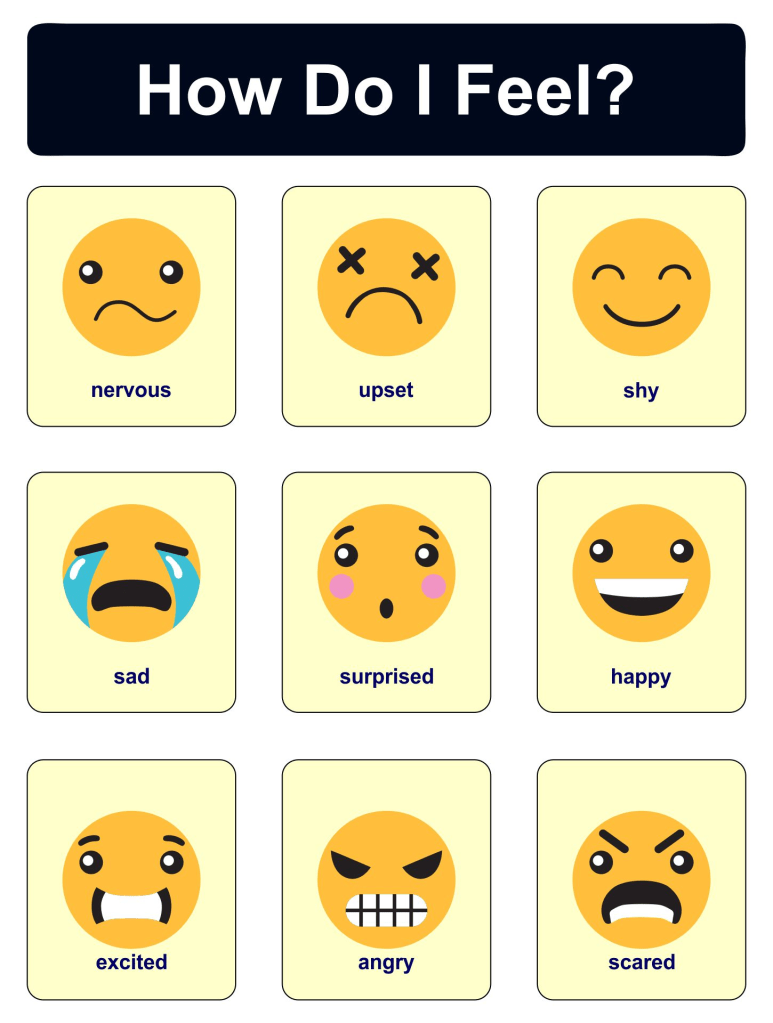
In childhood, when you might not have been able to articulate your emotions, you likely found comfort in referring to this chart and pointing to the image that reflected how you felt. It was empowering for you to effectively express how you felt so that your teacher could quickly and efficiently help you ease your discomfort. However, once you left that classroom, it’s possible that you may not have encountered such diverse displays of emotions again. It may have also been the last time you felt that your needs were truly met as a result.
Outside of the classroom, our family and friends played a crucial role in developing our emotional intelligence. Despite receiving advice from our community on managing emotions, we learned by observing and directly experiencing the ways in which they processed emotions.
It is my belief that, despite experiencing a wide spectrum of emotions themselves, many of our parents, influenced by their own past experiences, typically only expressed themselves through anger or happiness. Being our primary emotional role models we picked up on their patterns of processing feelings and as adults, we still mimic the behaviors we learned from our parents and community.
As a result, some people tend to simplify their emotions into two main categories: happiness and anger, relegating all other nuanced emotions under these broad categories. If a feeling is perceived as negative, it is automatically labeled as anger, regardless of its true nature. Positive or neutral emotions, on the other hand, are often interpreted as happiness. This is primarily how we navigate and process our emotions: as either good or bad, happy or mad.
How does a lack of emotional intelligence affect your life?
A lack of emotional intelligence can be harmful when dealing with negative feelings such as insecurity, worry, fear, or uncertainty, by responding with anger. People who have grown up in environments where emotions are oversimplified and suppressed tend to have a negative outlook on life and a persistent sense of pessimism about having their needs fulfilled.
Not being able to identify and name your feelings can lead you to shut out, push away, and close yourself off from other people who may be able to support you otherwise. Anger builds a wall between us and the opportunities we seek, isolating us and making us feel helpless, unloved, unsupported, and inadequate. The longer we operate in this pattern, the more ingrained this behavior becomes, and the worse we feel as a result.
The oversimplification of your emotions is a learned behavior that is standing in the way of you achieving the connections, success, and new opportunities you are looking for. Fully understanding and embracing your emotions, rather than simplifying and mislabeling them, is a direct path to cultivating a positive outlook on life and breaking free from unproductive patterns of behavior.
How do you cultivate emotional intelligence?
The simplest way to strengthen your emotional intelligence muscle is to develop and practice self-awareness. By becoming more aware of your emotions, you can slow down your mental processes and evaluate your true feelings to determine where they are coming from and what you need to express so that your needs can be met.
Creating space between your initial feeling and reaction will allow you time to sit with the feeling and let the initial intensity subside. This gives you the opportunity to truly understand what you are feeling. It may be challenging at first because facing your feelings means allowing yourself to experience them. And, depending on when and where the feeling is triggered, it could lead to uncomfortable displays of emotion and trigger another set of emotional responses that you will have to learn to manage in the moment. But rest assured that the effort will be well worth it. As you practice you will notice an improvement in your emotional resilience. You will become more open and approachable and you’ll get to enjoy the rewards of having your needs met and gaining clarity on when it’s time to set boundaries to protect all the hard work you’ve put into improving your mindset.
Developing and practicing self-awareness does not need to be something you take on by yourself. In fact, if you are someone who uses anger to mask your deeper feelings, I would strongly encourage you to work with a therapist or coach to help guide you and support you on your journey.
If you are interested in working with me to develop your self-awareness and guide you through the processing of your emotions, send me your information through the contact page, and I will follow up with you within 24 hours.


Leave a Reply